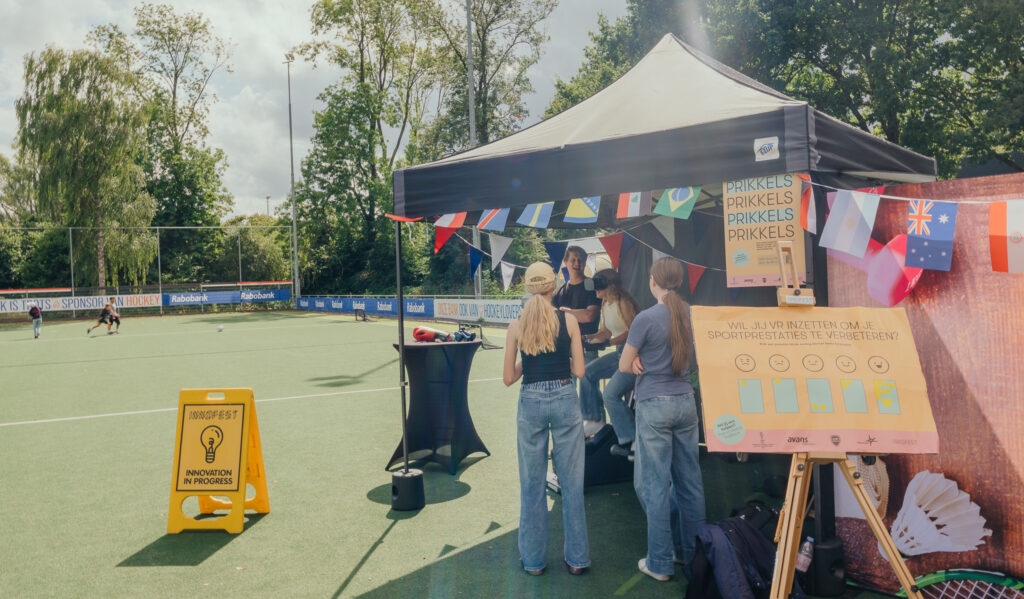
Sport zonder ruis, a collaboration between Avans University of Applied Sciences and MyHealth, explores how a calmer sports environment can make exercise more accessible to people who are sensitive to sensory overload. This includes people with dementia, neurodivergent people and young adults from Generation Z.
To experience the concept without having to redesign a gym, the team created a VR experience of the low-stimulation sports environment. During the Hockey World Cup 2026, 39 adult visitors tried the VR experience and completed a questionnaire before and after the session.
The need for a calmer environment was clear. Before the experience, 71.8% said they sometimes felt uncomfortable in a busy sports environment and 69.2% preferred a quieter setting. After the VR experience, 89.7% found the environment calm and easy to navigate, while 87.2% experienced fewer stimuli. 76.9% felt comfortable.
The step from ‘this feels good’ to ‘I would actually exercise here’ was smaller. 64.1% said they would like to exercise in this type of environment and 41% expected they would exercise more often. When asked about future use, 43.6% said yes, 38.5% maybe and 17.9% no.
Another interesting finding: low-stimulation does not mean silent or empty. Participants wanted choice. Music, soft background sounds, nature, plants, colour and the option to have more or less social interaction all came up. Some preferred having their own personal ‘bubble’.
The results are exploratory, as the test involved a small convenience sample, no control group and a single measurement. The next step is to test the principles in a real gym and measure actual behaviour, such as visit frequency, exercise duration and repeated use. The team will also involve people for whom sensory accessibility is especially relevant more directly.
A master’s student in Healthy Society will continue the research with more data and further testing with Gen Z at Avans. The Week of Vitality at Avans will be another opportunity to test the VR experience and explore how different generations respond to a low-stimulation sports environment.
And there is one more question to explore: perhaps ‘Sport zonder ruis’ itself could use a name that makes people even more curious.
In collaboration with: Regieorgaan SIA, Sportinnovator and MyHealth.